top of page


THE SITUATION.


KEY DEVELOPMENT CHALLENGES.
Treo.Ai set out to make panoramic sports video capture accessible beyond elite-level teams. Their vision was a compact, intelligent camera system that could automatically record and analyse gameplay.
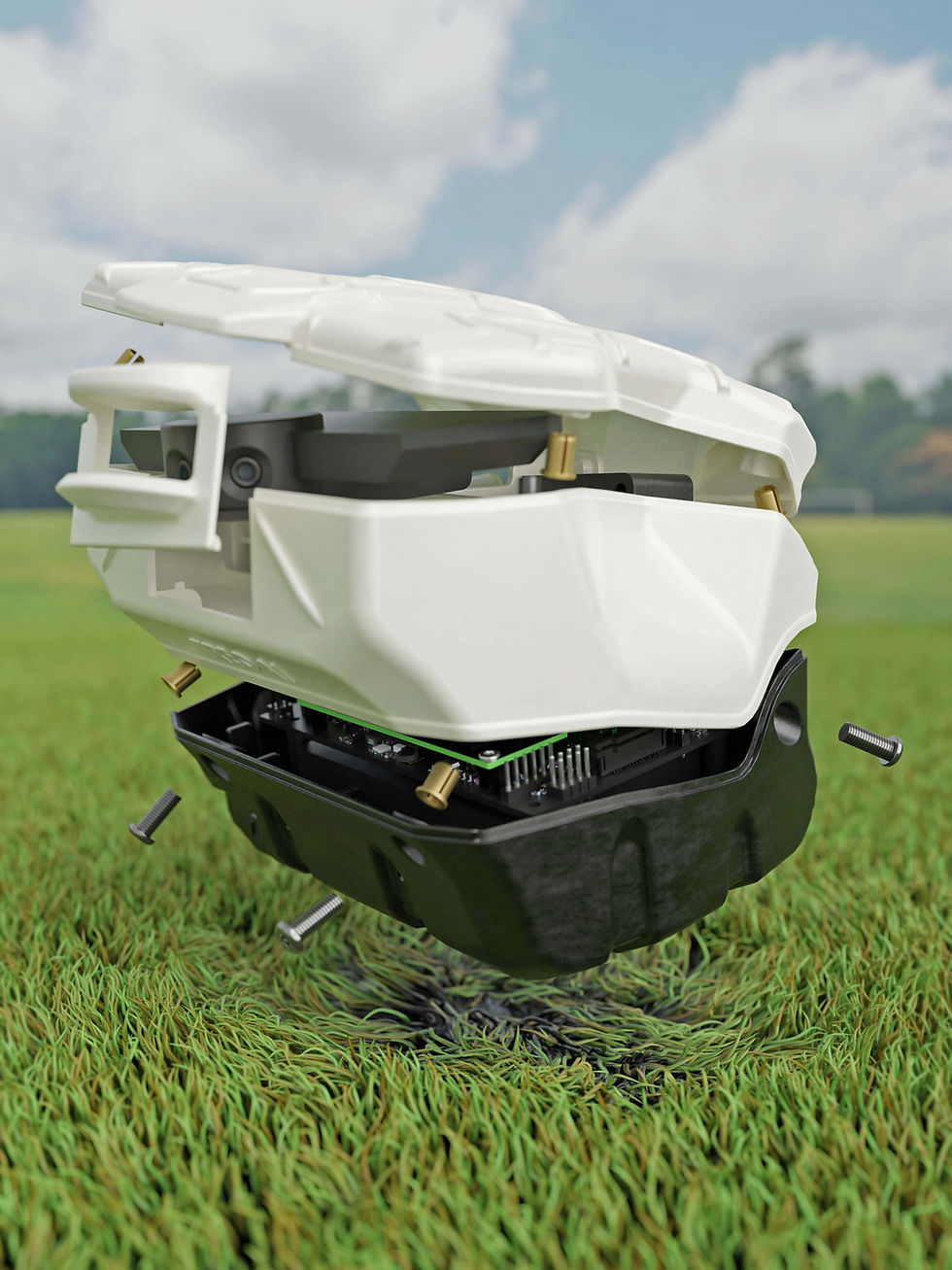
To achieve this, the product needed a housing that could integrate electronics, withstand outdoor use and be manufactured efficiently at low volumes.
We were brought in to develop the product from early concept into a fully resolved, manufacturable design.
Developing a housing for electronics is not just about form - it requires resolving multiple constraints simultaneously.
The product needed to:
01. Protect sensitive internal electronics.
02. Be suitable for outdoor environments (durability and water resistance).
03. Support interchangeable internal camera modules.
04. Deliver a strong commercial and visual presence.
05. Be optimised for additive manufacturing, not traditional tooling.
Unlike injection moulding, additive manufacturing removes tooling costs and minimum order quantities, making it ideal for low-volume production - but it introduces its own design constraints and considerations.
The challenge was to create a product that balanced all of these factors without compromising usability or manufacturability.


OUTCOMES.
The project resulted in a fully resolved product ready for real-world use and production.
-
Developed from early concept to a functioning physical product.
-
Designed to house AI-enabled camera technology within a compact form.
-
Modular internal configuration allowing different camera setups.
-
Multiple prototypes created and tested to validate design decisions.
-
Final design aligned with additive manufacturing requirements and was produced successfully.
The result is a product that balances usability, durability and manufacturability - enabling Treo.Ai to bring their technology to market.
"Very creative, fast and professional designers. Amazing design work. They were very helpful and informative about the design and manufacturing process."
Founder, Treo Ai, 2021
DESIGN FOR ADDITIVE MANUFACTURING.
A key part of the project was designing specifically for additive manufacturing rather than adapting a traditional design.
Additive manufacturing enables:
-
Greater geometric freedom and complexity.
-
Reduced part counts through integration.
-
Cost-effective production at low volumes.
-
Faster iteration during development.
However, it also requires careful consideration of:
-
Wall thickness and structural integrity.
-
Print orientation and surface quality.
-
Assembly and post-processing.
-
Integration of internal components.
The housing was designed from the ground up with these constraints in mind, ensuring the final product could be reliably produced without redesign.
SETTING THE FOUNDATION.
Rather than jumping into detailed design, we structured development around key decisions - ensuring the product direction was clear before progressing.
Early stages focused on:
-
Defining the overall product architecture.
-
Understanding internal component layout and constraints.
-
Exploring how additive manufacturing would influence form and construction.
-
Establishing a clear design direction aligned with both user needs and production realities.
From there, the design was progressively refined through CAD development and prototyping, resolving usability, assembly and structural considerations step by step.
From concept to additive manufacturing-ready electronic housing.

Turning an AI-powered sports camera into a manufacturable product.
Client: Treo.Ai | 2021
Our Role: Hardware Development & Design for Additive Manufacturing
Privacy Policy | © 2026 Abtin Valerie
Abtin Valerie Ltd. | UK Company No: 15488879
bottom of page