top of page




OUTCOMES.
The project resulted in a distinctive gaming controller concept developed around alternative interaction and practical low-volume production.
-
Developed an alternative form and geometry to differentiate the controller from existing market options.
-
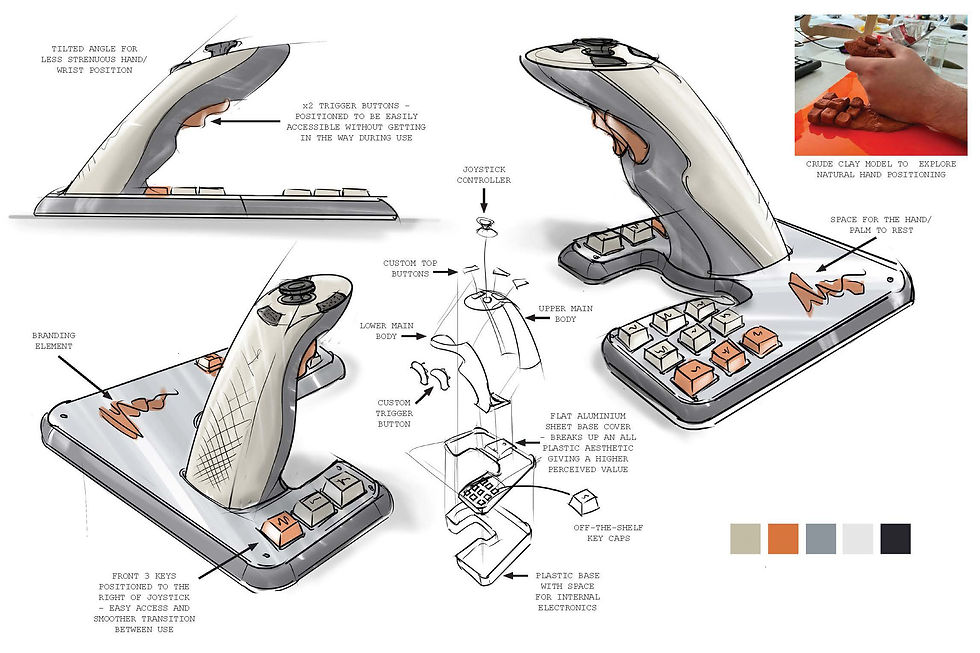
Brought joystick, keyboard and handheld controls together within a single product architecture.
-
Considered ergonomics and control positioning around users with lower levels of dexterity.
-
Simplified the component structure to reduce manufacturing complexity and cost.
-
Developed internal cavities and component layouts around the required electronics.
-
Considered assembly, maintenance, cleaning and everyday durability throughout development.
-
Optimised the enclosure for low-volume, made-to-order manufacture.
-
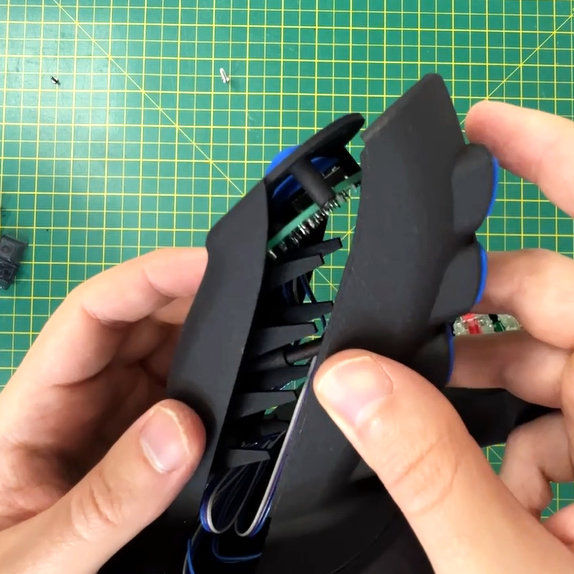
Developed and physically prototyped the design to evaluate the product architecture and interaction.
The result was a more resolved gaming peripheral that brought together alternative control, distinctive industrial design and a production strategy appropriate for low-volume manufacture.
Electronics Engineering Partner: Damian Ochendal
our approach.
Development began by reviewing the existing concept and exploring how its overall architecture, ergonomics and visual identity could be improved.
The initial design was developed for ambidextrous use. Through iterative prototyping, however, the intended interaction became clearer: the user's right hand would typically remain on the mouse, while the controller replaced the keyboard inputs normally operated by the left hand. This shifted the product towards a dedicated left-hand configuration, allowing the form and control layout to be developed more specifically around its intended use.
As the design progressed, the required components, internal architecture and functions also became better defined, allowing the overall form to be progressively simplified and refined.
Key areas of development included:
-
Ergonomics & accessibility - refining the position, scale and relationship of the different controls around easier physical interaction.
-
Product architecture - developing the enclosure around the joystick, keyboard switches, buttons and other electronic components.
-
Component reduction - simplifying the construction and reducing unnecessary unique parts to help control low-volume manufacturing costs.
-
Assembly & maintenance - considering fixings, internal access and how electronic components could be installed and maintained.
-
Form development - moving away from the geometry of existing products to establish a more recognisable and independent design language.
-
Low-volume manufacture - refining components around manufacturing methods suited to made-to-order production rather than investing in high-volume tooling.
KEY DEVELOPMENT CHALLENGES.
The product needed to balance accessibility and ergonomics with electronics integration, manufacture and a distinctive gaming aesthetic.
01. Reduce reliance on the fine motor movements associated with conventional keyboard controls.
02. Establish comfortable positioning and access across the joystick, keys and handheld controls.
03. Create sufficient internal space for the required electronics and connections.
04. Minimise the number of unique components to simplify manufacture and assembly.
05. Develop an assembly strategy that allowed components to be accessed for maintenance.
06. Avoid unnecessary dirt traps and consider resistance to everyday spills and moisture.
07. Differentiate the form from existing gaming controllers and competitor products.
08. Optimise the design around low-volume, made-to-order production rather than conventional mass manufacture.
The challenge was therefore not simply to create a different controller form, but to develop a product architecture that could balance usability, electronics and realistic production constraints.
Alternative WASD Gaming Controls for Lower-Dexterity Users.


THE SITUATION.
Abtin Valerie was approached with an early concept for a gaming controller intended to replace the main functions traditionally performed through WASD keyboard controls.
A preliminary 3D model and physical prototype had already been created, providing a starting point for further development. A key objective was to reduce the reliance on fine motor control and create a more inclusive way of accessing common gaming inputs for users with lower levels of dexterity.
The design also needed to establish its own identity within the gaming market while being practical for low-volume, made-to-order production.
Developing an alternative gaming controller around ergonomics and accessible interaction.
Client: Optrig | 2022
Our Role: Product Strategy, Industrial Design, CAD Development, Prototyping and Design for Manufacture
Privacy Policy | © 2026 Abtin Valerie
Abtin Valerie Ltd. | UK Company No: 15488879
★★★★★ Google Rated, Insured & NDA Ready
bottom of page